Write Tomorrow First: How Future Journaling Gets Your Mind Working for You
 By Todd Bilodeau7 min read
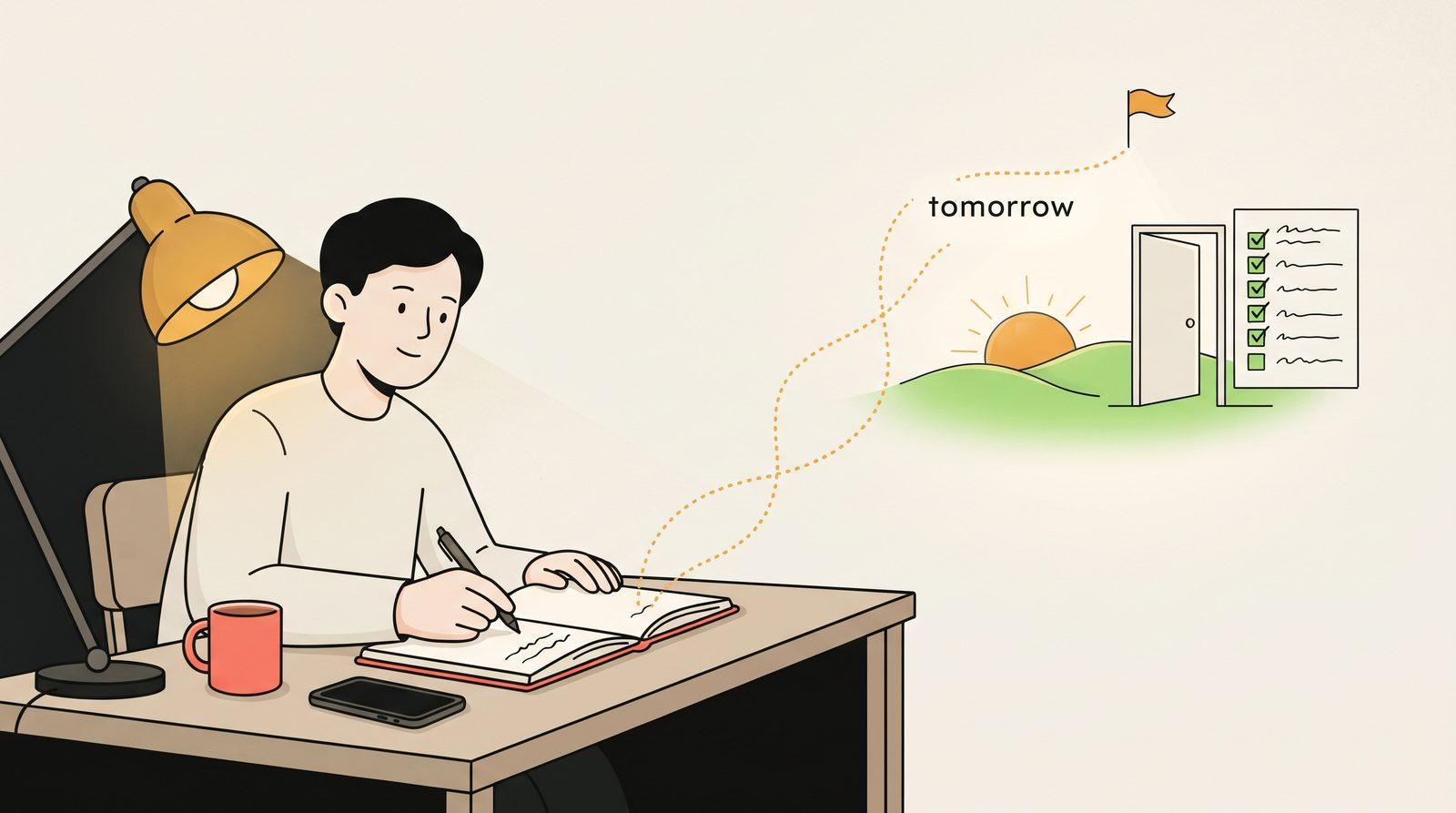
Most journaling looks backward. You write about what happened, how you felt, and what went sideways. That has real value. But there's another way to use a blank page that I've found surprisingly powerful: write tomorrow before it happens.
Future journaling means writing tomorrow's entry tonight, in past tense, as if the day is already done. Not "I will finish the proposal." Instead: "I finished the proposal by 11. The pricing section was the hard part, so I tackled it first while my head was clear, and by lunch it was off my plate."
It sounds like a small trick of grammar. In practice, it's one of the simplest ways I know to get your mind working with you instead of against you.
Why Your Mind Sometimes Works Against You
Two things quietly get in the way of most goals.
Vague worry. Unfinished goals nag at us. In a set of studies published in 2011, psychologists E.J. Masicampo and Roy Baumeister found that unfulfilled goals kept intruding on people's attention while they tried to do other tasks. But when people made a specific plan for that goal, the intrusive thoughts dropped away, even though the goal itself wasn't done yet. That low hum of "I really need to deal with that" isn't a sign you care. It's a sign your brain doesn't have a plan.
Vague wishing. The opposite trap is daydreaming about success. Psychologist Gabriele Oettingen has spent decades studying this, and her research shows that pure positive fantasies about an ideal future can actually lower energy and effort. Your mind gets a little taste of the reward and relaxes before you've done any of the work.
So the goal isn't just to think positively about tomorrow. It's to think concretely about it. That's where future journaling, done well, earns its keep.
What Happens When You Write Tomorrow First
1. You Rehearse the Process, Not Just the Outcome
In a well-known 1999 study, Lien Pham and Shelley Taylor asked college students to spend a few minutes each day before a big exam imagining either getting a great grade or the actual process of studying: where they'd sit, what they'd review, how they'd handle distractions. The students who pictured the process studied more and scored higher. The ones who only pictured the A didn't get a boost.
A good future journal entry is a process rehearsal. You're not writing "Tomorrow was amazing." You're writing what you did, in what order, and how it went.
Application: Write at least two or three sentences about how the day went, not just what got done.
2. You Turn the Obstacle Into a Plan
Oettingen's answer to the fantasy trap is called mental contrasting: picture the outcome you want, then picture the real obstacle in the way. Paired with a simple plan, it's known as WOOP (Wish, Outcome, Obstacle, Plan). The "plan" piece comes from Peter Gollwitzer's work on implementation intentions, which are if-then plans like "If the 2 p.m. slump hits, then I'll take a ten-minute walk." A review of 94 studies found these simple if-then plans had a meaningful effect on whether people followed through, and a 2021 meta-analysis found that combining mental contrasting with implementation intentions reliably helps people reach their goals.
Future journaling lets you build that right into the story: "Around 2, I hit the usual slump. I took a quick walk around the block, came back, and knocked out the last section."
Application: Include one moment where something got in your way, and write how you handled it.
3. You Give Your Brain a Problem to Work On
Neuroscience research led by Daniel Schacter and Donna Rose Addis suggests the brain uses much of the same machinery to imagine the future that it uses to remember the past. When you write tomorrow in vivid, specific detail, you're making it feel more real, and studies on this kind of "episodic future thinking" show it can help people weigh long-term rewards over short-term temptations.
There's also something to be said for writing it at night. Research on problem solving shows that stepping away from a problem after working on it, often called incubation, tends to help solutions surface. Writing tonight and sleeping on it gives your mind the whole night to chew.
You may have heard this explained as the reticular activating system "filtering" the world for your goals. That's a simplification most neuroscientists would push back on. But the everyday version holds up: once a goal is clearly active in your mind, you start noticing what's relevant to it. It's the same reason you buy a red car and suddenly see red cars everywhere.
Application: Write tomorrow's entry in the evening, then let it go. Notice what ideas show up by morning.
4. You Quiet the Noise
Remember those nagging, unfinished goals? Writing out how tomorrow went is a plan. Once your brain has one, it can stop sounding the alarm. In a 2018 sleep-lab study, Michael Scullin and colleagues found that people who spent five minutes at bedtime writing about what they needed to do in the coming days fell asleep faster than people who wrote about what they'd already finished. Getting tomorrow out of your head and onto the page seems to let your mind rest.
Don't Skip the Look Back
The second half of the habit is just as important: the next evening, look back at what you wrote and compare it to what actually happened. Not as a scorecard, but as feedback. Did you overestimate how much fits in a morning? Did the obstacle you predicted show up, or a different one? Over a few weeks, your entries get more realistic, and your days start lining up with them more often.
How to Start: Five Minutes a Night
- Pick one thing that matters tomorrow. One meeting, one task, one conversation.
- Write in past tense. Catch yourself on "I will" and "I'm going to," and rewrite it as done.
- Describe how, not just what. Where you were, what you did first, how it went.
- Name one obstacle and how you handled it.
- Note how it felt when it was done.
- Tomorrow night, look back. What matched? What didn't? Then write the next one.
Here's what a short entry can look like:
"I got to the office early and blocked the first hour for the budget review. Email tried to pull me in, but I left it closed until 9:30. The numbers came together faster than I expected, and I walked into the 2:00 meeting prepared instead of scrambling. I felt calm and in control all afternoon."
Try It in FutureJournal
I built FutureJournal to make this habit easy to stick with. It's a simple, phone-friendly web app where you write tomorrow's entry in past tense. It gently nudges you when "will" or "going to" sneaks in, offers prompts when you're stuck, lets you tag how you want to feel, and keeps your past entries so you can see your progress. In the evening, it asks how the day actually went, so the look back is built right in. Your entries stay on your device.
Start your first future journal entry at journal.leadinspiregrow.com
Bottom Line
Future journaling isn't magic, and it isn't wishful thinking. It's rehearsal, planning, and reflection packed into five minutes and written as a story. Done well, it turns vague worry into a plan and vague wishing into a path.
My takeaway: Your mind is going to think about tomorrow either way. Give it something useful to work with.
Write it tonight. Live it tomorrow. Look back and learn.
Sources
- Gollwitzer, P. M., & Sheeran, P. (2006). Implementation intentions and goal achievement: A meta-analysis of effects and processes. Advances in Experimental Social Psychology, 38, 69–119.
- Kappes, H. B., & Oettingen, G. (2011). Positive fantasies about idealized futures sap energy. Journal of Experimental Social Psychology, 47(4), 719–729.
- Masicampo, E. J., & Baumeister, R. F. (2011). Consider it done! Plan making can eliminate the cognitive effects of unfulfilled goals. Journal of Personality and Social Psychology, 101(4), 667–683.
- Oettingen, G. (2014). Rethinking Positive Thinking: Inside the New Science of Motivation. Current.
- Peters, J., & Büchel, C. (2010). Episodic future thinking reduces reward delay discounting through an enhancement of prefrontal-mediotemporal interactions. Neuron, 66(1), 138–148.
- Pham, L. B., & Taylor, S. E. (1999). From thought to action: Effects of process- versus outcome-based mental simulations on performance. Personality and Social Psychology Bulletin, 25(2), 250–260.
- Schacter, D. L., Addis, D. R., & Buckner, R. L. (2007). Remembering the past to imagine the future: The prospective brain. Nature Reviews Neuroscience, 8(9), 657–661.
- Scullin, M. K., Krueger, M. L., Ballard, H. K., Pruett, N., & Bliwise, D. L. (2018). The effects of bedtime writing on difficulty falling asleep: A polysomnographic study comparing to-do lists and completed activity lists. Journal of Experimental Psychology: General, 147(1), 139–146.
- Sio, U. N., & Ormerod, T. C. (2009). Does incubation enhance problem solving? A meta-analytic review. Psychological Bulletin, 135(1), 94–120.
- Wang, G., Wang, Y., & Gai, X. (2021). A meta-analysis of the effects of mental contrasting with implementation intentions on goal attainment. Frontiers in Psychology, 12, 565202.
More in Grow

High-Leverage Delegation: Build Systems Where Your Team Makes Good Decisions Without You
High-leverage delegation is the art of empowering your team to make sound decisions independently, freeing you to focus on strategic leadership. This approach...
By Todd Bilodeau · Jun 1, 2025 · 2 min read

How to build Rapport quickly and effectively!
For about 10 years in the early 2000's I moonlighted from corporate America as a Comedy Stage Hypnotist. It was an absolute blast. I got to meet and entertain...
By Todd Bilodeau · Aug 10, 2021 · 5 min read

Coaching vs. Managing: When to Direct, Coach, Delegate, or Support Based on Team Maturity
In the dynamic world of leadership, understanding when to manage and when to coach is crucial. Both approaches are essential, but knowing when to apply each...
By Todd Bilodeau · Jun 1, 2025 · 1 min read